Your Bones Called. They Want You to Lift Something.
A midlife guide to osteoporosis, strength training, and choosing the right personal trainer
Most women don't think much about their bone health until something goes wrong: a fracture, a scan result that comes back worrying, a doctor mentioning osteoporosis as though it was always going to happen.
It doesn’t need to inevitable, even if you have a family history of it. What you do now, or start doing now, makes a real difference.
What's actually happening to your bones
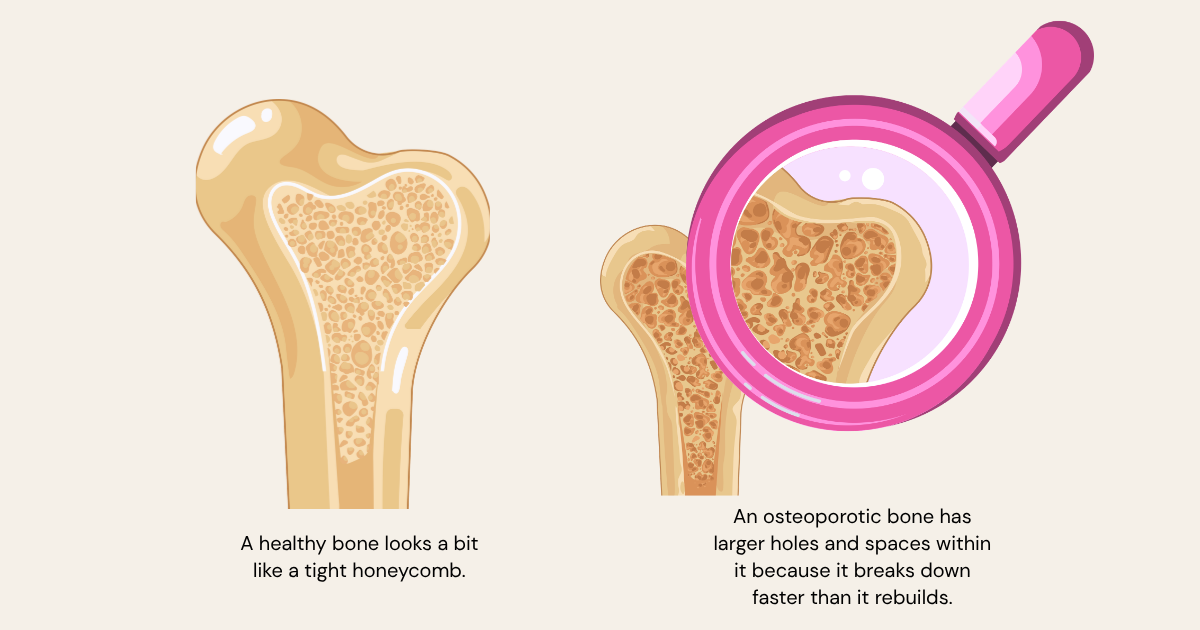
Bone is living tissue,it's constantly breaking down and rebuilding, and for most of your life those two processes roughly balance out. Bone density peaks in your mid twenties, and from your forties onwards, the balance starts to shift the other way, so that your bone reduces in density.
Women lose around 0.5% of bone density a year from their forties. Around menopause, that rate increases significantly.
Oestrogen plays a key role in maintaining bone density, so as it drops during perimenopause and menopause, bone loss speeds up. Women also tend to have a lower peak bone density than men to begin with, so the losses is greater! This is why women are significantly more likely to develop osteoporosis, where bones become brittle and fracture more easily, or osteopenia, the stage before that.
The important part is this: bone responds to load. Like muscle, it follows a use it or lose it principle. Which means the good news is there's a lot within your control here.
Why strength training matters
When you lift weights or do any form of resistance training, you're putting load through your bones. That load acts as a signal, prompting your body to remodel and strengthen the bone tissue.
The research supports this. Strength training has been shown to slow bone density loss, and in postmenopausal women it can even increase it in some cases.
You don't need to lift heavy from day one. You need to start loading your bones, consistently, and build from there.
Beyond bone health, strength training in midlife also supports:
Muscle mass, which naturally declines with age and affects metabolism, strength and energy
Balance and coordination, which reduces fall risk as we get older
Joint health and mobility
Mood, sleep and energy levels
Confidence and a sense of capability
High-impact movement has a role too, things like jumping jacks, skipping or brisk walking load the bones in a different way to lifting. You’re going to get the most benefits if you do a mix of both.
The other pieces of the puzzle
Exercise will give the biggest benefits, but bone health isn't only about what happens in the gym.
Calcium and vitamin D matter. Calcium is a key mineral in bone structure, found in dairy, leafy greens, tofu and fortified foods. Vitamin D helps your body absorb and use it. Sunlight is the main source, but most of us in the UK need to supplement (NHS recommended), particularly over winter, most supplements are made from lanolin (sheep’s wool) but you can also get vegan versions that use mushrooms for the vitamin d source.
Protein is closely linked to bone density too. It’s a good idea to aim for a palm-sized portion at most meals. Many women in midlife are eating less than they need, I know it can feel overwhelming. This isn't a case for eating less: restrictive dieting weakens bones, and your body needs adequate energy to maintain them properly. So, although it can feel challenging, it’s really worth looking at getting enough protein from whole food soureces as much as possible.
Alcohol and smoking are both recognised risk factors for osteoporosis. I’m sure that won’t come as a surprise, nobody’s ever suggesting that there are any positive attributes to either of those!
One source that surprised me to find out recently is (drum roll): prunes. A 12-month randomised controlled trial in postmenopausal women found that 50g of prunes a day (around 5 to 6 prunes) prevented loss of hip bone density over the course of the study. Earlier research using a higher dose, 100g a day or roughly 9 to 10 prunes, showed bone density increases of up to 1% a year in postmenopausal women with osteoporosis or osteopenia. It's not a substitute for medication or strength training, but as a simple daily habit alongside both, it's a genuinely useful one. Who doesn’t like a new extra snack, I like prunes, so I’ll be grabbing those as they’re also a valuable contributor to my fibre too!
A note on scans: it's a common assumption that you'll be called up for a bone density (DEXA) scan automatically once you reach a certain age, in the way you might be invited for a mammogram. In the UK, unfortunately that isn't the case. There's no routine, age-based screening programme. A DEXA scan happens only following a GP referral, usually after a risk assessment such as FRAX or QFracture, based on factors like early menopause, family history, previous fractures or long-term steroid use. If you're concerned about your bone health, particularly if you went through menopause early, it's worth raising it with your GP yourself rather than waiting to be asked.
If you have osteoporosis and you're looking for a personal trainer
This bit matters, so I want to be direct about it. If you've been diagnosed with osteoporosis, not every personal trainer is qualified to work with you safely. General fitness qualifications don't cover the specific adjustments needed around load, spinal flexion, and movement selection for someone with reduced bone density.
At minimum, look for a trainer who holds the Level 3 Diploma in Supporting Clients with Long Term Conditions (Active IQ), or an equivalent recognised qualification covering long-term health conditions. This is the qualification that specifically covers working with clients who have osteoporosis and other long-term conditions, and it's what allows a trainer to programme appropriately and safely around your diagnosis rather than just adapting a standard programme and hoping for the best.
I hold this qualification myself, alongside my strength coaching credentials, so if this is something you're navigating, it's an area I specifically work in.
It's a reasonable question to ask any trainer directly: what's your qualification for working with clients with long-term conditions? A good trainer will be glad you asked.
What this looks like in practice
You don't need to overhaul your whole life. Here's a simple starting point:
Aim for 2 to 3 strength training sessions a week. That's enough to see real benefits.
Include compound movements: squats, deadlifts, rows, presses. These load multiple muscle groups and multiple bones at once.
Add some impact: a walk, a jog, some jumping. Your bones benefit from variety.
Sort your protein. A palm-sized portion of chicken, fish, eggs, lentils or Greek yoghurt at most meals is a good starting point.
Get outside for vitamin D, and supplement over winter, or year-round if you're mostly indoors.
If you have risk factors for osteoporosis, raise it with your GP. Don't wait to be asked.
If you already have a diagnosis, make sure your trainer is properly qualified to work with you.
If you're not sure where to start with strength training, get some support. The learning curve is shorter than you'd think, and you don't have to work it out on your own.
Your bones have been doing their job quietly for forty-odd years. It's time to give them something to work with.
Rosie x